
With the buying spree over, the Leafs have continued the turnover of the roster that was started at the deadline. Instead of presenting the recent moves as a measure of John Chayka, let's instead look at it from the roster perspective. That is the job after all, having a better team than last year.
Out
Forwards
- Bobby McMann
- Matias Maccelli
- Max Domi*
- Nick Robertson
- Nic Roy
- Scott Laughton
- Calle Järnkrok
Defence
- Brandon Carlo
- Simon Benoit
Goaltenders
- Joe Woll
- Dennis Hildeby**
*presumably out at least for the start of the season, perhaps permanently
** not really an NHLer, but he did appear in 20 games because of injuries
In
Forwards
- Teddy Blueger
- Brandon Duhaime
- Nick Paul
- Jack Roslovic
- Colton Sissons
- Zack MacEwen
Defence
- Darren Raddysh
- Chris Tanev***
Goaltenders
- Sergei Bobrovsky
*** assumed to be returning from an essentially missed season
Still to Come
Contracts Needed
- Gavin Mckenna
- Emil Andrae
- Jacob Quillan****
Training Camp Heroes
(very unlikely to start the season in the NHL unless there are injuries)
- Ben Danford
- Tinus Luc Koblar
- Artur Akhtyamov
Potentially Traded
- Morgan Rielly
- Phil Myers
**** Quillan would need to also be a training camp hero to make the roster, but he played 23 games last year so he appears as a needed contract
Salary Cap
First, I will give you the standard disclaimer about the offseason. The "cap space" you see on any salary cap site is not offseason cap space. It is a projection of the next season's roster with assumptions made about who will be in the AHL.
Now and until deep into training camp there is no AHL. All contracted players are on their NHL rosters. Offseason cap space is calculated in a complex way that I never do unless there is some likelihood of an issue, but it involves the entire roster. There is no compelling reason to calculate this.
In the offseason, in addition to the actual cap space calculation, teams are allowed to exceed that cap ceiling by 10%. No team needs a cap-compliant roster of 23 healthy players until the first day of the season.
Projected Cap Space
As of today, PuckPedia lists 14 forwards including Max Domi who is on IR, so only 13 are projected to the roster. They list seven defenders including Andrae and two goalies. This projected roster is slightly over the cap.
Pay Andrae a reasonable amount in accordance with projected contracts and put Domi on LTIR and the roster has 22 players and is almost exactly at the salary cap.
Sign McKenna to an ELC and send MacEwen to the AHL and there's likely a small difference to be sorted out in time.
Obviously a trade of Rielly instantly produces $7.5 million in projected cap space.
Again. The roster is not set until October. Any player can be added to this roster, and the cap situation sorted out later.
State of the Team
The defence is radically improved but also tactically useful in new ways.
The forward corps is now full of players who can move around the lineup playing wing up the lineup, centre down the lineup and who complement better players, are focused on defence and are fairly young considering they arrived on July 1. There is talk of speed and genuine physical effectiveness for most of these additions.
The forward concept is not unlike the techniques used by Florida, Tampa, Vegas and (previously) Boston to support an expensive core of forwards and top defenders. There is a very obvious weakness in scoring ability in the new members of the forward corps so that has to be balanced out by things like contesting with the Oilers for the best power play in the NHL, as they should be always have been doing, as well as reducing both the time spent in the defensive zone and the overall goals against.
The Zippy Little Winger is dead, long live the Energetic Big Forward.
Let us go back in time to when Kyle Dubas left and Brendan Shanahan hired Brad Treliving. He chose to keep Sheldon Keefe as coach, and he added Tyler Bertuzzi to the lineup – a big-bodied forward who also has scoring ability. He also added Max Domi, a player with offence creation as his only skill who has the reputation of a player who is physical that is wholly undeserved.
My belief at that time was that the Leafs were declining in their ability to possess the puck for enough time in each game to have enough offensive opportunity to outscore their opponents. This is borne out by the numbers. Their once very effective offensive cycle was cycling a lot less often.
There's more than one way to address that problem. Because outscoring your opponents – have you heard, that's the point of the game – can be achieved in more than one way.
The choice (and let's take it as read that choices are constrained by who is available and who you can actually get) was to try to add some physicality upfront and take a risky move on signing John Klingberg to add some puck skills to the defence. Klingberg needed surgery, and didn't work out, but neither did he detract from the team in his 14 whole games played. All of this tinkering around the edges got the Leafs into the playoffs and some of their weaknesses were easily exploited on defence and boom, game over. But Treliving's plans were largely based on adding offence all over the lineup. Not defence.
This then was the real fork in the road. The path Treliving chose was to try to address goals against with Anthony Stolarz and the defence with Oliver Ekman-Larson and Chris Tanev in and Timothy Liljegren and Mark Giordano out. He then filled out the team with very cheap depth players and continued the great Maple Leafs tradition of a third line that had no role, no purpose and were usually very terrible. He gave this roster to Craig Berube who struggled from day one to find a useful role for either Nick Robertson or Max Domi.
The idea was to rely hard on the stars who can score to win games and just not lose the minutes when Auston Matthews was not on the ice – fair enough. But the structure put around them required those same stars to also be the possession drivers, the offence creators, the transition masters while almost no one could defend. This is Craig Berube's good season:
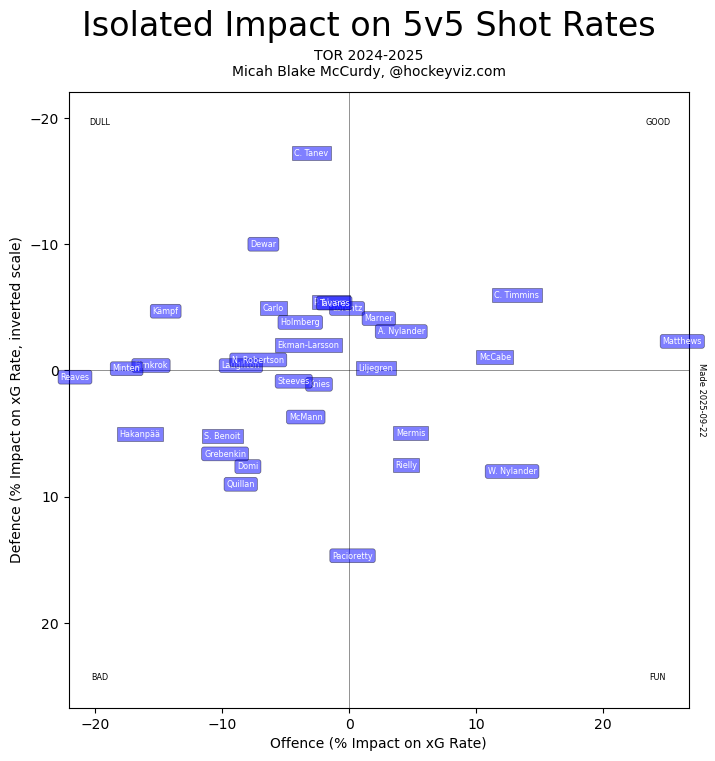
Who is any good at all? Matthews, Nylander, McCabe, Marner (ish) and Morgan Rielly. The entire depth is snowed under so hard, the only one left to shovel out a path to the offensive zone was Anthony Stolarz and Joe Woll. None of them even managed to be dull to an effective degree. Most notably, John Tavares was losing his minutes and was not adding any offence. They were a one line team.
The idea had been to take the hard work away from the stars and give it to guys of limited offensive skill, and the reality was it was piled on. Why? Well my guess is because Brad Treliving is one of those guys who will say that analytics is all well and good, but it can only tell you so much and blah, blah, blah. He wouldn't know an effective defensive/physical/transition forward if the guy punched him in the nose. Affect and effect. Yes, it's that line again, but all he could see was an illusion of truculence.
The right path now is not to grab the wheel and turn the bus around and try to go back to the high-flying days of Mike Babcock's wild offence. That was more effective at diverting attention from the black hole on defence/goal but only to some extent.
The right path now is to do what Shanahan appeared to understand – and I'm pretty sure Kyle Dubas was aware of as well – and create some shutdown lines full of minute eaters and qualified PKers, to have enough centres, to have enough players who don't need to be exhorted to check occasionally – this was a legitimate complaint of Berube's about his players. That he repeatedly made it in public is a reflection on those players as well as on him.
It's handy that using real player evaluation, top quality scouting and good decision making also fills up the roster without dropping $5 million or more on a 13 minute player because he skates real fast. You can't have those guys when the choice has been made to do that same thing Treliving did in getting Stolarz only more so in both stature, reputation and cost with Sergei Bobrovsky.
So what has Chayka emphasized? The power play and transition with Raddysh, stopping the puck with Bobrovsky, and defence and transition from the depth forwards. The puck needs to be controlled and be moved to win this game.
This is supposed to put those few guys who were good back two years ago in the offensive zone more, and with less effort expended getting there. (McKenna would really, really benefit from this in his rookie year.) From that increase in scoring chances from the actually talented and the power play possibly not being awful comes more goals for. From that decrease in defensive zone time and the goaltending comes fewer goals against.
The margins here are small. The difference between a 56% possession team (name your measure) and 50/50 muddle middle team is a swing of about three or four minutes in a single game. Seriously. It's a handful of shots that are now for instead of against.
Consider that concept. This is one of the many, many reason this sport is so confounding to the best laid plans of any GM. The trip from okay team to great team is a tiny step that requires infinite amounts of effort to take.
What wasn't added? Defensive defenders and scoring forwards. Both things are lacking, particularly the defenders, and the goalies are going to have to cover for them, while the stars do for the offensive weakness in the peripheral players. At least for now. Transition is going to have to substitute for defending skill some of the time. Some of the time, that's okay.
The risk here is that the offence has to really sing with the top six on the ice. Really click. The defence has to really click with the goaltending. The puck really has to move and be under control. Then the hands of fate that meddle with all systems have to keep the GF - GA solving for the right answer.
Less GF than in the "good old days" but also less GA. For real this time.
What else? I'd trade Morgan Rielly and find a defensive defender in case Chris Tanev is not his old self. Because even if he is, that's not a bad thing to have. I'd love another guy with offensive skills, but maybe that's going to be McKenna and we get what we get.
This is a two-year bet. The Leafs have 11 players under contract in 2028-2029 with McKenna making it an even dozen one he's signed. Three of them are in their last year.
And remember, whoever is there now is not the opening night roster, and the opening night roster doesn't have to play every game.
Some of the prospects:
And the new guys from Wednesday:
That's it for now. Free agency is not over, there are a lot of teams miles away from the cap ceiling with serious holes in their lineup that they can't fill internally.
Take a look at the numbers in this excellent post:
https://puckpedia.com/news/july-1-charts-tables-recapping-wild-start-nhl-free-agency
Have a great day, see you on Saturday.


